




How to Keep a Greenhouse Cool — And Why a Growing Dome Is Designed for It
Keeping a greenhouse cool in summer can be a challenge. Traditional greenhouses often trap heat and aren’t designed to manage hot summer temperatures.
A Growing Dome® is designed with heat management in mind from the start. The structure integrates airflow, light diffusion, and thermal mass to reduce heat stress naturally, minimizing the need for extra inputs.
Below are the most effective ways to keep a greenhouse cool and how the Growing Dome addresses each by design.

Before We Go Further: What ‘Too Hot’ Really Means for Plants
Before we get too far into this topic, we need to talk about an important distinction.
A greenhouse that feels hot to you isn’t automatically too hot for plants.
Plants experience heat very differently than people do. Many plants tolerate higher air temperatures than humans, as long as airflow, ventilation, humidity, and root-zone temperatures are properly managed. What causes plant stress isn’t warm air alone, but stagnant air, overheated roots, and sudden temperature spikes.
This is why focusing only on air temperature can be misleading. A greenhouse can feel uncomfortably warm to step into while still providing a healthy growing environment for plants.
Growing Domes are designed around plant comfort first, allowing warm air to rise and escape, roots to stay cooler, and air to keep moving even during hot summer days.
Use Plant Transpiration to Cool Your Greenhouse Naturally
Plants play an active role in greenhouse cooling through transpiration and strategic shading. As plants release water vapor through their leaves, heat is absorbed from the surrounding air, creating a localized cooling effect. This process is most effective when plants have adequate water and airflow, allowing transpiration to continue even during warm conditions.
Positioning larger, shade-producing plants on the west or southwest side of the greenhouse provides the greatest benefit, as this is where afternoon sun and heat intensity are highest. Broad-leaf plants intercept direct sunlight before it reaches the interior, reducing radiant heat while creating cooler microclimates beneath the canopy.
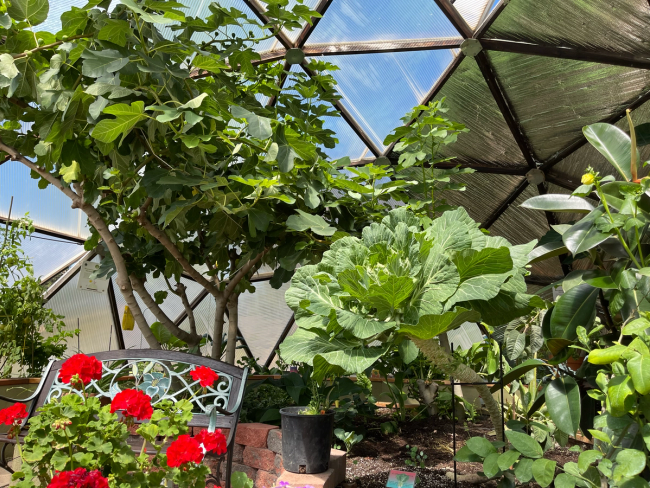
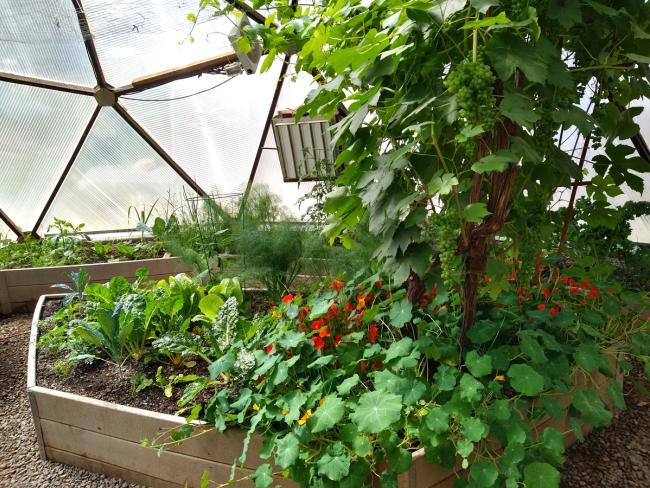
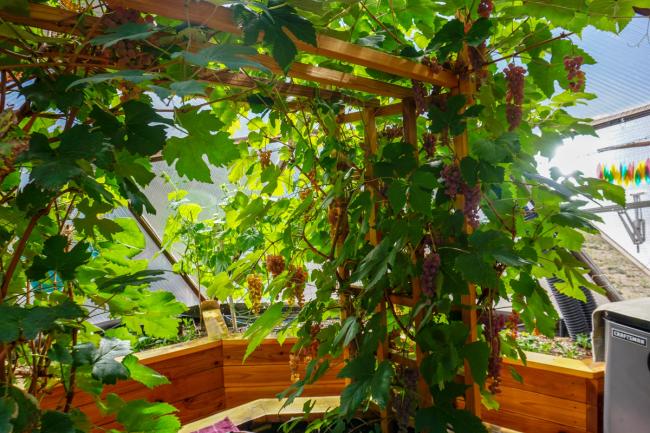
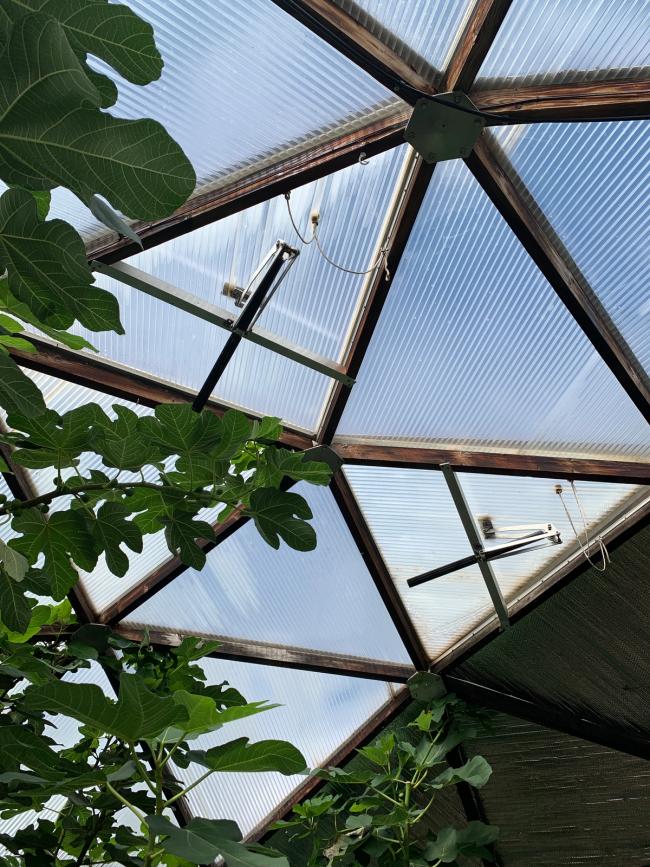
Deciduous plants, such as fig trees or grape vines, are especially well suited for this role because they provide seasonal shade. In summer, their dense foliage offers significant cooling through both transpiration and light interception, while in winter they naturally shed leaves, allowing full sunlight to reach the greenhouse when heat gain is desirable.
However, these plants take time to establish and reach a size where they can provide meaningful shade. In newly planted greenhouses, a shade cloth can be especially helpful, offering immediate reduction in solar heat gain while living shade systems develop and mature. This is why we include one in every Growing Dome kit.
Thermal Mass: How Water Stabilizes Temperature
Thermal mass works in a greenhouse because water absorbs and releases heat much more slowly than air. While air temperature can rise and fall quickly throughout the day, water resists rapid temperature change due to its high specific heat capacity. If you’ve ever placed your hand in a pond or a pool on a hot afternoon and noticed how cool it feels, you’ve experienced this effect firsthand.
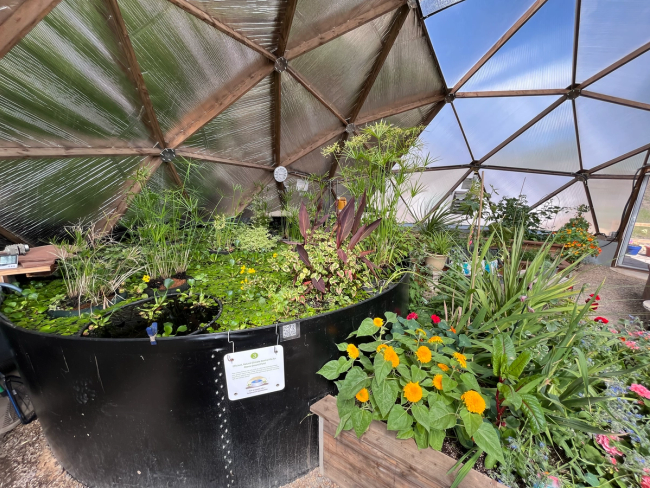
Dark-colored surfaces can help absorb radiant heat, but the stabilizing effect comes from the water itself. This is why even simple systems, such as dark-painted containers filled with water, can function as effective thermal mass. The above-ground pond in a Growing Dome applies the same principle at a larger scale, buffering air temperature and supporting more stable growing conditions overall.
While thermal mass is effective at moderating temperature, it does not circulate air or remove heat on its own. Heat can still become trapped in stagnant air without ventilation. For thermal mass to work as intended, it must be paired with systems that move air — allowing warm air to rise, escape, and be replaced with cooler air. This is why ventilation and airflow are essential companions to any thermal mass strategy in a greenhouse.

Pro Tip!
In warm climates, raised bed materials matter. Stone and concrete beds can store heat and raise greenhouse temperatures, while lumber beds absorb less heat and help keep conditions more stable in summer.
Ventilation and Air Circulation: Moving Heat Out and Air Through the Dome
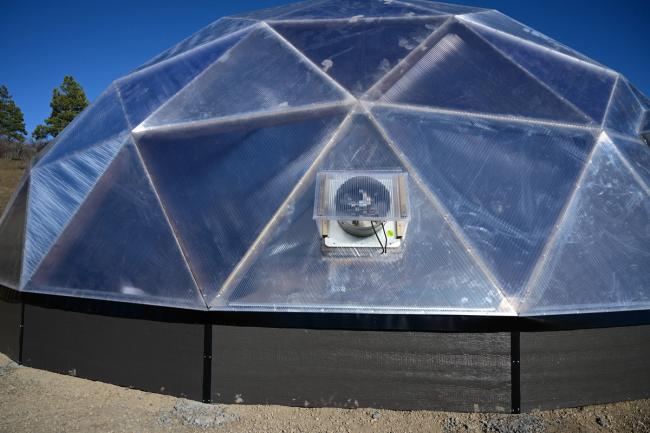
Ventilation is essential for removing heat from a greenhouse, something thermal mass alone cannot do. Passive ventilation allows warm air to rise and escape through upper vents or exhaust fans while drawing in cooler outside air through lower vents or fans. This natural chimney effect helps prevent heat from becoming trapped at plant level and creates a continuous exchange of air with the outside environment.
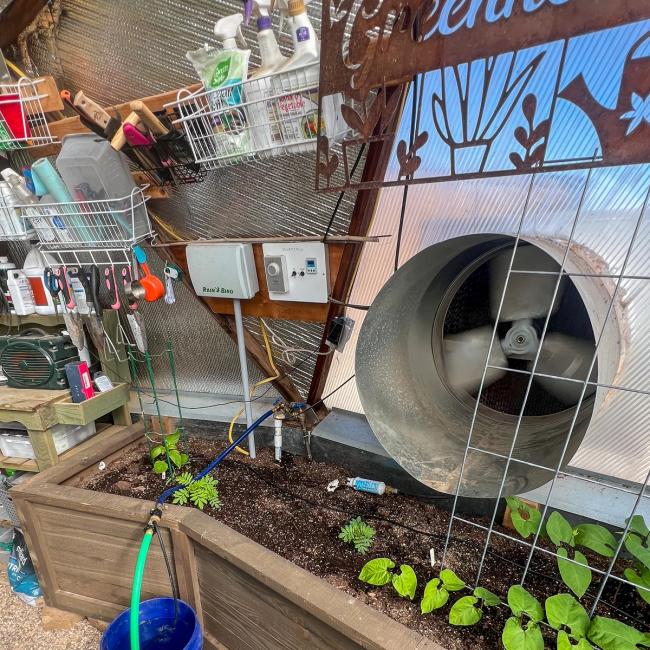
Active ventilation supports this process by keeping air moving when natural airflow is limited. Fans help circulate air evenly throughout the dome, reducing hot pockets and preventing stagnant conditions. In addition to above-ground airflow, the undersoil system contributes to internal air circulation by using a fan positioned behind the pond to pull air through a pipe beneath the raised beds and exhaust it on the opposite side of the greenhouse. While this system does not necessarily heat or cool the soil, it helps move air through the lower portion of the dome, supporting more uniform temperature distribution and working in coordination with vents and circulation fans to manage heat effectively.

What If That Isn’t Enough? Supplemental Cooling Options
In some climates or during periods of extreme heat, passive design and ventilation may not be sufficient on their own. When this happens, some growers choose to use supplemental cooling techniques to further reduce heat stress. The effectiveness of these methods depends on local climate conditions, particularly humidity.

Evaporative Cooling Techniques
Evaporative cooling works by adding moisture to the air, allowing heat to be absorbed as water evaporates. These methods are generally most effective in hot, dry climates and less effective in regions with high humidity.
Common evaporative techniques include:
- Hosing down the floor or hard surfaces, which can temporarily lower air temperature as the water evaporates
- Misting systems, which introduce fine droplets into the air to increase evaporative cooling
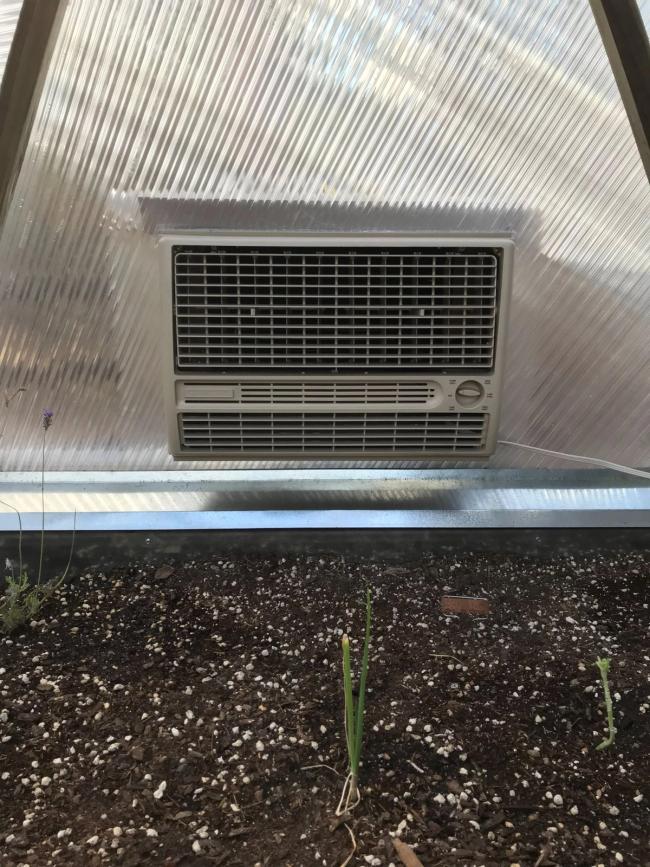
- Evaporative coolers aka swamp coolers, which actively pull air through wet pads to reduce air temperature
While these approaches can reduce heat in the short term, they also increase humidity. In humid climates, this may limit effectiveness and increase the risk of fungal disease if airflow is insufficient.
The Main Difference Between Evaporative Cooling and Air Conditioning
Evaporative (swamp) coolers lower temperature by adding moisture to the air and require fresh air to move through the space to work effectively. Air conditioners lower temperature by removing heat and moisture from the air and work best when cooled air is kept inside. One depends on air exchange to function, while the other loses efficiency when air is exchanged.
Air Conditioning
In hot, humid climates, evaporative cooling methods are often less effective because the air is already moisture-saturated. In these conditions, some growers explore mechanical air-conditioning options, including ductless mini-split systems, as a supplemental tool for managing temperature and humidity.
Air-conditioning systems work most efficiently in more enclosed environments, which means they are typically used selectively rather than continuously in a greenhouse setting. During periods when air conditioning is in use, ventilation may be reduced to improve efficiency. At other times, ventilation is restored to support plant health and air exchange.
Air conditioning is not a replacement for greenhouse ventilation. Instead, it is a situational option that may be used during extreme heat or humidity events, particularly for sensitive crops or specific growing goals. Energy use, system sizing, and operational tradeoffs should be carefully considered.
How the Growing Dome Reduces the Need for Added Cooling
All of the cooling strategies covered here — ventilation, airflow, shading, plant transpiration, thermal mass, and internal air circulation — were considered in the design of the Growing Dome from the very beginning. Rather than relying on add-on equipment or after-the-fact fixes, the dome integrates these principles into the structure itself so heat can move out, air can keep circulating, and temperatures can stay more stable through the hottest months of the year.
For many growers, this means you can operate your Growing Dome without purchasing additional cooling equipment or making major modifications. In some climates, especially during periods of extreme heat or high humidity, supplemental cooling options may still be useful. But the goal of the Growing Dome design is to reduce how often and how much extra cooling is needed, so you can focus more on growing and less on managing temperature.