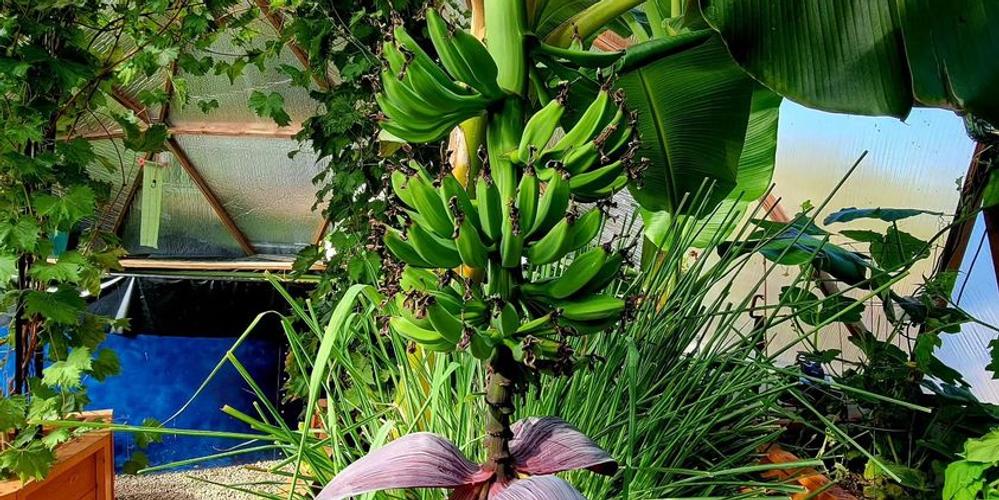
Peeling Back the Secrets of Growing Bananas

In this guide, you’ll learn how banana plants grow in a greenhouse, where to place them inside a Growing Dome, why heat and humidity matter, how to manage pups and harvests, and what cold-climate growers should know before planting a tropical fruit crop.
Often called a tree, the banana is an herbaceous plant as it does not have a woody stem. Banana is in the Musaceae family and is more closely related to cardamom and ginger than to any type of palm. You are going to love growing bananas!
Can You Grow Bananas in a Greenhouse?

We know many of you go bananas over bananas, and growing them IS possible in a greenhouse or your Growing Dome! Bananas grow quickly in tropical and subtropical regions where there is a hot and humid climate. Banana flowers will typically appear in about six months. The purple petals will start to curl up and drop off, revealing your bananas.
While you may have noticed those little black “seeds” in your store-bought bananas, they are immature and will not grow a banana plant. Commercial bananas are mainly the Cavendish variety, grown from rhizomes (horizontal plant stems). Most of our current-day varieties of bananas are now seedless. If you are determined to grow bananas from seeds, be aware it is challenging, as they will require very precise tropical conditions!
Want a quick reference while you plan? Download our free banana growing guide for care tips and harvest reminders.
Free Download
What We’ve Learned from Growing Dome Banana Growers
Bananas are not just a tropical daydream for greenhouse gardeners. Growing Dome owners have successfully grown bananas in climates far outside the plant’s usual comfort zone, including Bjorn Oliviusson’s 33-foot Growing Dome in Sweden at 60 degrees north latitude.
In that cold, windy climate, Bjorn found that bananas handled the warm, humid greenhouse environment better than many traditional annual crops. His dwarf Cavendish banana plants grew rapidly, flowered, and produced large bunches in a heated dome. His experience is a helpful reminder that bananas can be a realistic greenhouse crop when they are given enough warmth, humidity, space, and winter protection.
What Bananas Need in a Growing Dome

Photo Credit: Kevin and Erin Sharp
- Best location: Warmest bed, often near the center and close to the pond
- Light: At least 6 hours of direct sun; 8–10 hours is better
- Humidity: Higher humidity preferred; misting may help
- Cold-climate note: Heating is usually needed for reliable tropical fruit production
- Propagation: Grow from pups or rhizomes, not grocery-store bananas
- Fruiting: Each stem fruits once, then the rhizome sends up new stems
- Best varieties: Dwarf varieties are usually more practical for greenhouse height limits
Where to Plant Bananas in a Growing Dome
Banana is a tropical plant, so it will need to be in the warmest area of your dome. Typically that is the center bed and close to the above-ground pond, which also acts as your thermal mass, providing heat in the winter.
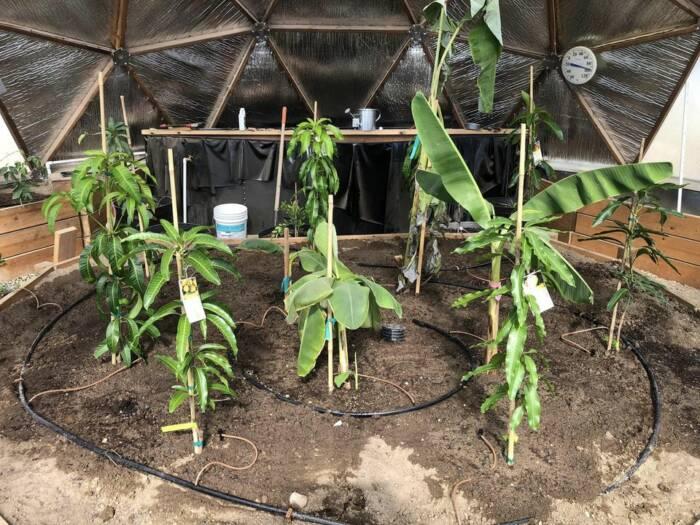
Banana plants also need a minimum of 6 hours of sunlight per day, but 8-10 hours of full sun is better. Planting your banana in the center also allows room for banana plants to reach their full height, although there are banana plant varieties that come in varying heights to fit your greenhouse.
Dreaming of Tropical Fruit in Your Greenhouse?
A Growing Dome can help create the protected microclimate tropical plants need, even in challenging climates. Talk with our team about your dream garden.


Photo Credit: Kevin and Erin Sharp
Heat, Humidity, and Sunlight for Greenhouse Bananas
Most banana varieties prefer full sun and grow best in USDA Zones 9-11; however, there are banana plants that can scorch easily and like partial shade. You can keep your banana plant happy in your greenhouse by providing a warm, humid climate with at least 6 hours of direct sunlight. Did you know that there are hundreds of varieties of bananas? Dwarf varieties are popular for smaller gardens, and the red varieties are a beautiful addition to your garden or greenhouse.
How to Plant a Banana Plant or Banana Pup
You can take a banana rhizome, called a banana pup, and grow a new banana plant via that method. Propagate new banana plants by separating the suckers from the parent plant. There are usually multiple pups growing from the parent, but it’s best to leave at least one, as the plant will only produce fruit for one season.

Photo Credit: Lacy Beerman
Dig a hole that is deep and wide enough so the soil around the plant will be loose. This allows the banana roots to grow into the soil easily, which also helps stabilize the banana as it grows tall. Mix compost and manure in with the soil from the newly dug hole until it is about a 50/50 mix. Plant your banana plant so the top of the soil from the pot is either level or slightly above the raised bed.
Be sure to add a combination of trimmed banana leaves, fertilizer, and hard mulch frequently during the growing season, so they have the necessary nutrients to grow and remain healthy. This also helps prevent weeds and keeps the soil moist. A soil pH between 5.5 and 7 will help your banana plant grow healthy.
Banana plants like rich, dark soil, so be sure to add a lot of compost. They also need quite a bit of nitrogen and potassium…chicken manure is a good option. Another option for hungry banana plants is to plant them in a banana circle. This is a permaculture method that allows them to thrive as they would in the wild. If you only want to plant one banana plant, be sure its neighbors like a lot of water.
Do Banana Plants Only Fruit Once?
Banana plants can live for six years, although each stem only produces fruit once and then dies. The plant will continue to produce new stems from the rhizome for your next bunch of fruit.
Companion Plants for Bananas in a Greenhouse

Photo credit: Bill George
Banana plants are best grown in a banana circle, as mentioned earlier. They like to have a circle of friends…companions! The following plants are great companions for your banana plant: sweet potatoes, comfrey, taro, and lemongrass.
- Sweet potatoes provide ground cover for the soil, which also helps retain moisture, and since they are a vine, they can grow up the banana plant.
- Comfrey grows well in the shade provided by banana plants and contributes minerals and nutrients to the soil that your ravenous banana plant will devour!
- Plant taro, a root vegetable, to provide ground cover to prevent the soil from drying out and weeds from taking root.
- Lemongrass is a culinary herb that is wonderful to have growing in your greenhouse. It’s also a natural pest and weed deterrent.
Watering, Fertilizing, and Caring for Banana Plants
Banana plants need rich, well-drained soil. Water deeply and regularly, but do not overwater your banana plant or let the soil become waterlogged, which can cause root rot. As tropical and subtropical plants, bananas also need humidity, so consider installing a misting system for your banana plant or add a humidifier in your greenhouse near your tropical plants.

Photo Credit: Paul Coleman, 2022
Bananas need fertilizing throughout the growing season because they have voracious appetites! Commercial fertilizer is one option, and using compost and mulch is another option. You want your banana plants to have very rich soil throughout the growing season, and you want to mix compost in annually to build up your soil.
Greenhouse Pest Considerations for Bananas
Banana plants can be attractive to pests, so keep an eye out for snails, spider mites, and aphids. Since banana plants require frequent watering, use a hose to shoot pests off with a jet of water or use an organic pesticide. Beer traps can be an effective solution for dealing with snails and slugs. They are also good for catching pill bugs. They are not for the squeamish, though, as you will have to empty the traps once they have caught the critter.
Growing Bananas Year-Round in Cold Climates
As a tropical plant, bananas require a tropical environment, just like guava. If you live in a cold region, planting any tropical plant will depend on one major decision: will you heat your Growing Dome or not? If you will not be heating your dome greenhouse, then planting a banana plant may not be wise. For those who plan on heating their greenhouse, the banana plant will be happiest where it will get the most sun and has room to grow both tall and wide.

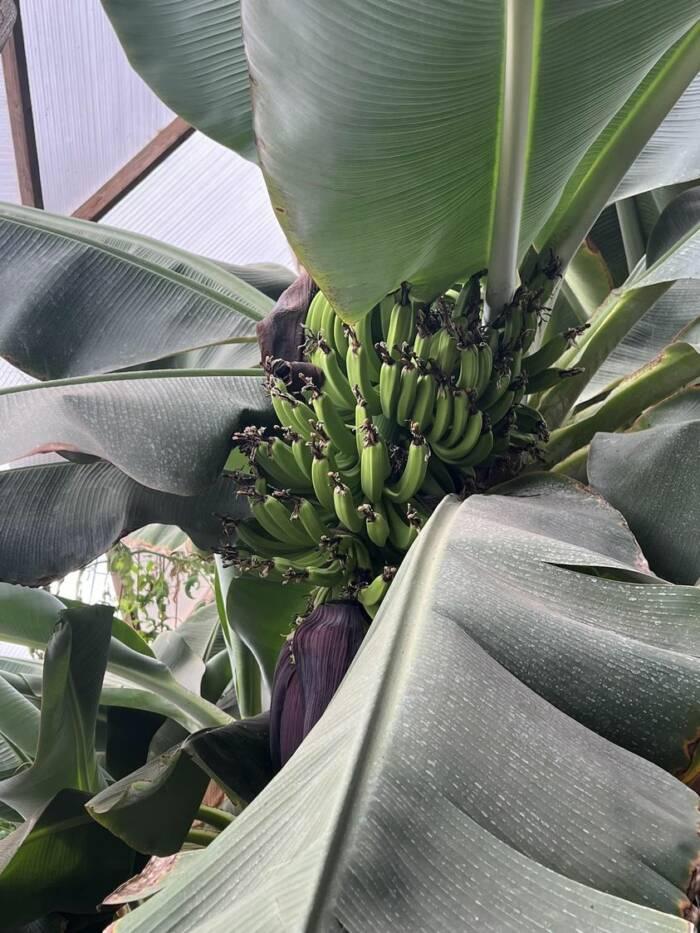
Bananas ready to harvest Photo Credit Jeff Lederle August 2020
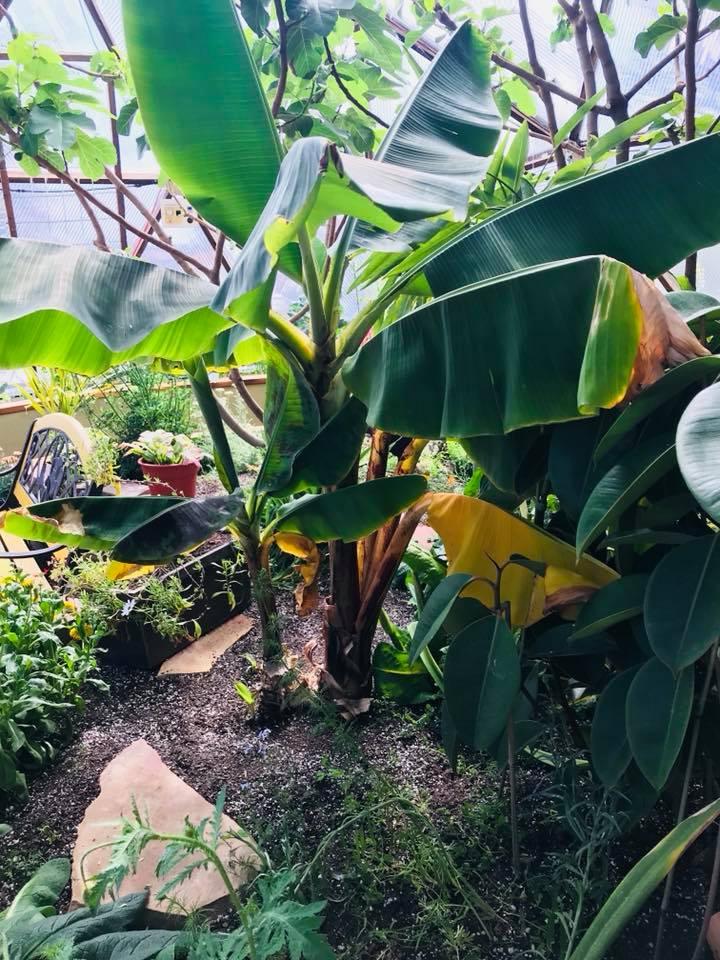
Bananas growing in a Dome
When and How to Harvest Bananas
Cutting banana plants to harvest them is a very messy job, and the plant sap will stain your clothes, so dress appropriately! Well-rounded bananas with ribs are ready for harvest, especially when the flowers can be rubbed off. Or harvest them green and bring them inside to finish ripening. They are sweetest if left on the plant, but then will ripen all at once! It is also possible to peel and freeze bananas for later use if you have too many to eat.
A Few “Apeeling” Banana Facts
Domesticated in Southeast Asia around 8000 BCE, modern seedless bananas are Musa acuminata and Musa balbisiana hybrids introduced to the West by Alexander the Great.
- Bananas are herbs and berries; clusters are "hands" and singles are "fingers."
- Peels heal bruises and polish leather.
- Fibers are used for weaving; flowers and leaves symbolize luck and fertility in India.
- Debuted in the U.S. in 1876 at the Philadelphia Centennial Exhibition.
Rich in potassium and vitamins, bananas are versatile in smoothies or as egg substitutes. Happy gardening!
Ready to Grow Beyond Your Climate?
From bananas and guava to citrus and passion fruit, a Growing Dome can expand what is possible in your garden. Get a quote or take a virtual tour to start planning your year-round growing space.


Banana Plant FAQs
Do banana trees only fruit once?
No. Each banana plant stem fruits once and then dies back, but the underground rhizome can continue producing new stems for future harvests.
How do you grow a banana tree in a greenhouse?
Provide a consistently warm, humid climate that receives at least 6 hours of sunlight; it is recommended that you plant it in a large raised bed with rich dark soil and regular fertilizing.
Can you grow a banana tree from a banana?
You will not be able to grow a banana tree from a store-bought banana, as the fruit is infertile, and most bananas are cultivated through rhizomes.
How do you plant a banana tree or banana pup?
Divide a banana pup or rhizome from the parent plant, ensuring you leave at least one rhizome to continue fruiting. Dig a deep and wide hole to loosen the soil and amend with compost and fertilizer. Plant the pup at the same soil depth as you removed it from. Water well and fertilize regularly.
Can banana plants grow in cold climates?
Yes, bananas can grow in cold climates when protected by a heated greenhouse or Growing Dome to maintain stable warm temperatures and humidity.
Where should I plant a banana in a Growing Dome?
In a Growing Dome, it is recommended to plant your banana tree in the central bed to provide it with optimal light and the most stable temperatures.
How much sun do banana plants need in a greenhouse?
In any environment, banana plants need a minimum of 6 hours of sunlight per day.
Do banana plants need a heated greenhouse?
For reliable fruit production in a cold climate, yes. Bananas are tropical plants and grow best in warm conditions, with optimal growth often between 78°F and 86°F. Growth slows dramatically in cool temperatures and can stop around 50°F. While some rhizomes may survive brief cold dips, the above-ground plant can freeze and die back.

Seasonal Growing Tips & Greenhouse Advice
Monthly stories from our greenhouses, Growing Dome spotlights, and other gardening content


Share This

I joined Growing Spaces in 2021 as a gardener and now work with the Marketing and Social Media department. Formerly I was a kindergarten teacher and then worked as a Gardener and Volunteer Coordinator at Maui Nui Botanical Gardens in Hawai'i. Since moving to Colorado I have worked in the veterinary field and have been involved in therapy dog work visiting hospitals, schools and libraries with a national therapy group. My previous dog and I also worked as a crisis response team helping those affected by crises or disasters and were deployed through Hope Animal-Assisted Crisis Response (Hope AACR). Muppet and Maple are my current therapy dogs and we visit the library and hospital here in Pagosa Springs. Muppet is also a crisis response canine with Hope AACR. Outside of working and volunteering, I love growing native plants, flowers, berries, herbs and veggies at home, photography, hiking, horseback with my husband and hanging out with our dogs.
View full bioDownloads
Featured Categories
Seasonal Growing Tips & Greenhouse Advice
Monthly stories from our greenhouses, Growing Dome spotlights, and other gardening content
Featured Stories

Growing Bananas at 60 Degrees North


How to Succeed with Companion Planting


How to Grow Fruit Trees in a Greenhouse


Do you Need Fertilizer in a Greenhouse?

Featured Products


Sign up for The Happy Grower Newsletter
Once a month: stories from our gardens, Growing Dome spotlights, and what's in season in Pagosa Springs.